Showing posts with label Cheese. Show all posts

Wednesday, June 15, 2011

Cheese of the Week: Pont L'Evêque

     Last weekend, our good friends, Ehren and Dave, came to visit us here in Paris. It was wonderful to see them for so many reasons. First, they are great friends (Ehren read a poem written by my fourth-graders in our wedding last May). Second, Ehren and Dave were the first people to know Peter and I were engaged (since we got engaged on our trip out west, visiting them and our friend Kate in San Fransisco in 2009) and third, they love food and wine as much as we do (Ehren was a sommelier in SF and is an expert in southern Italian wines!). It's unbelievable but true that we actually didn't take a SINGLE photo while Ehren and Dave were here! We were too busy eating. We're hoping they'll share some of their photos with us.
Ehren and Caroline on our first trip to San Fransisco in 2007
     Of course, Ehren and Dave were thrilled to experience the market culture here in France, where young and old do their daily shopping at outdoor markets where one can buy not only pies, fresh-baked breads and cheeses, but also skinned rabbits, fresh 2-foot long fish, and duck hearts if one so desired. On Ehren and Dave's last day in Paris, we decided that we must have them experience our very favorite activity in Paris: Un pique-nique dans le Jardin du Luxembourg. We invited a few seasoned pique-niquing friends to join us and we sampled 2010's best baguette in Paris (2011's winner was closed, but our friends Dan and Vikram live near both award-winning bakeries!). Of course, our guests and we had picked out some nice cheeses to enjoy on our picnic.
     The cheese we brought from the market was called Pont-L'Evêque. It's made in the Normandy region. We chose to feature it this week because on Saturday Peter will be heading out to Normandy with his buddies to tour the D-Day beaches and pay hommage to the American soldiers who fought here in France in WWII. 
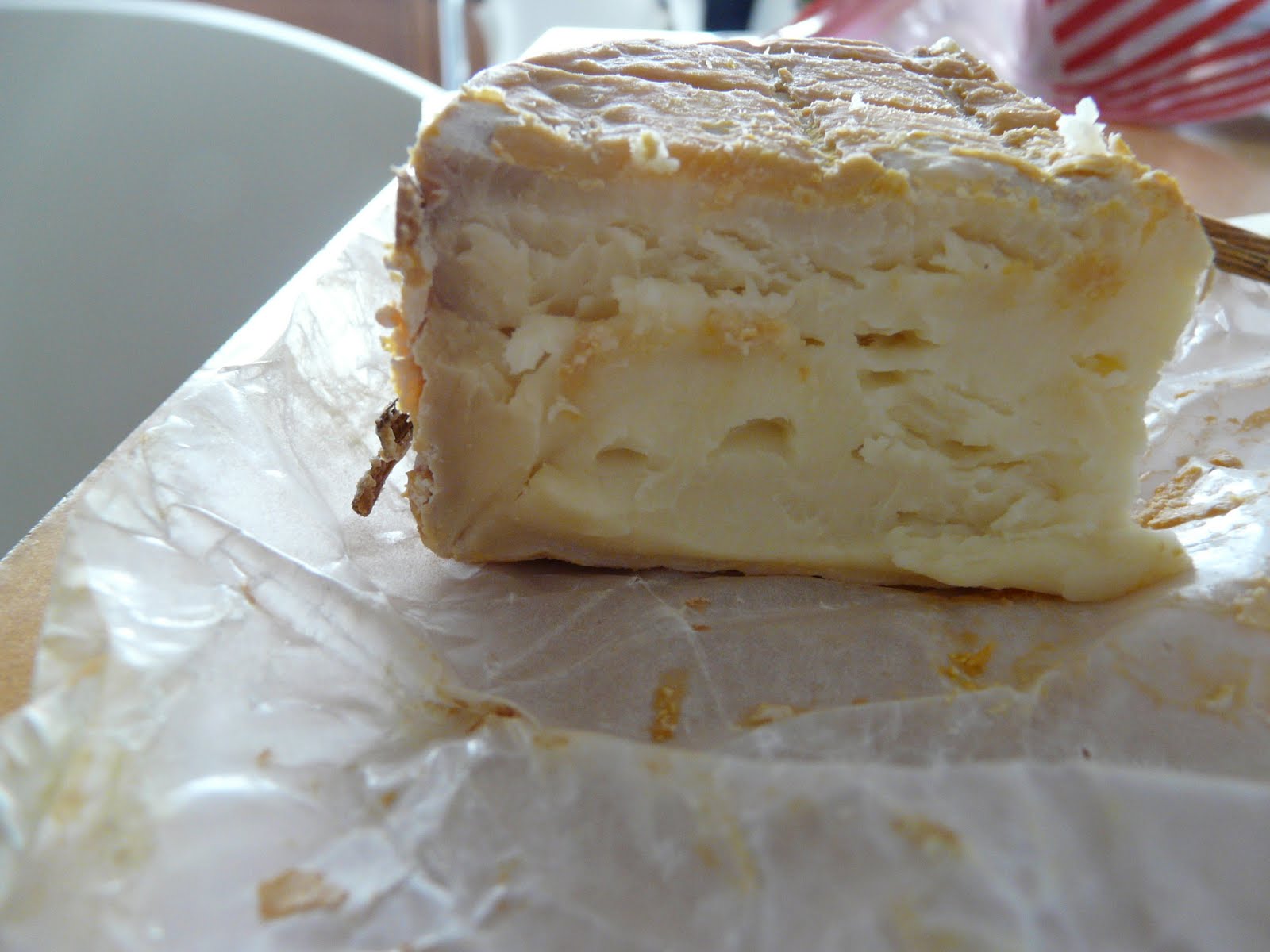
This cheese is a soft, uncooked cow's milk cheese. It is one of the oldest Norman French cheeses, and was originally known as Angelot. Legend has it that a manuscript from the 13th century claims that every fine meal should include some "Angelot". When the cheese became very popular in the 16th century, it took over the name of the town in which it was produced.
 Pont L'Evêque reached its full AOC status in 1976. There are a number of regulations cheesemakers must follow in order to give their cheese this name. One interesting regulation is that the milk must come from one of the departments surrounding the Normandy area. These departments include:  Calvados, Eure, Manche, Mayenne, Orne and Seine-Maritime. See them on the map below in the Northwest region of the country.
The 101 French Departments
This cheese is similar in flavor to Camembert and Brie cheese, and is produced not far from these. However, it has a slightly "stinkier" scent (in a good way) and a more grassy flavor. It is delicious, though, and is best eaten at room temperature. The rind is edible, and should not be cut off and left in a pile on the edge of your plate.
This cheese is slightly tangy with a good, strong cheese scent without being overpowering. It's a great cheese to bring on a picnic, and is served well on a dessert cheese platter. It goes great with a nice Gamay red wine, or even better with Champagne!

Thursday, May 26, 2011

Cheese of the Week: Bleu d'Auvergne

Bleu d'Auvergne is a cheese whose name describes it perfectly: it's a blue cheese from the Auvergne region in France. The Auvergne region is in southeastern/central France, and is known for its Roquefort and Fourme D'Ambert blue cheeses as well as Cantal which is one of our favorites.
Bleu d'Auvergne is simliar to Roquefort and Fourme d'Ambert, but it is creamier and milder. Instead of being made from ewe's milk like roquefort, this cheese is made from cow's milk like Fourme d'Ambert, which may explain why these two cheeses are more mild than the Roquefort. Bleu d'Auvergne is a "young" cheese in comparison to some of the others we've tried. It was developed in the mid 19th century when a young cheesemaker noticed that his cheese was developing blue veins. He soon noticed that the bread sitting nearby was developing a similar mold, meaning that each product was getting the same mold somehow, and eventually he developed the strategy of poking holes in his cheese to allow more air to enter and the blue veins to develop! Only a few years later, the French scientist Louis Pasteur confirmed that airborne germs were responsible for contaminating food products like breads and cheeses.


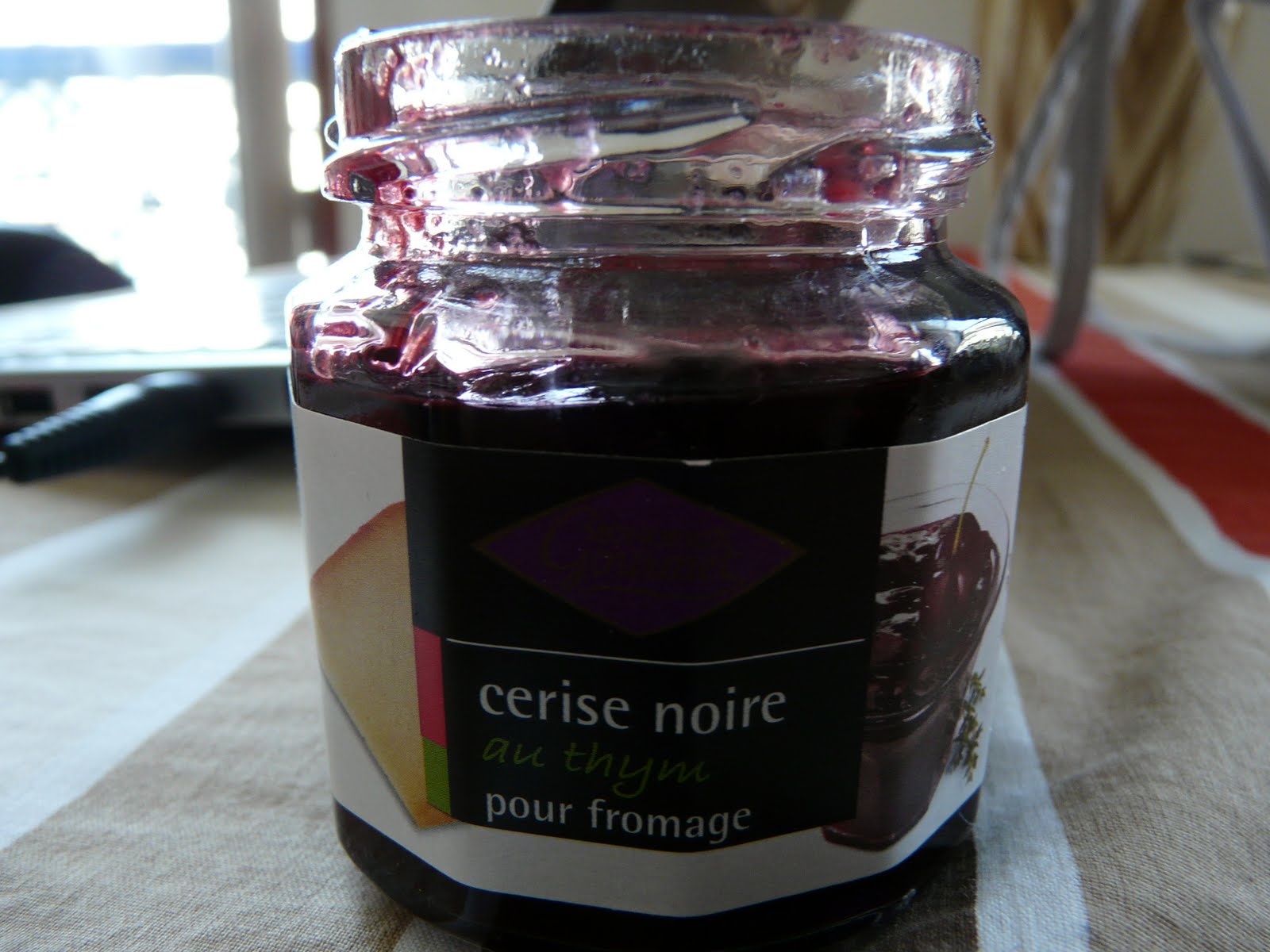
Cheese lovers who aren't typically excited by the pungent Roquefort but don't want to claim to "not like" blue cheese should give this one a try. It is mild and creamy and pairs beautifully with a slightly fruity Sauternes white wine, or some cherry and thyme jam.

Tuesday, May 17, 2011

Cheese of the Week: Valencay

 In two weeks time, we'll be taking our first trip to the Loire Valley. Peter's mom, Terumi, will be visiting us on her way to Switzerland and we all agreed that a little adventure would be fun. So, to prepare for our first time in the valley famous for its wines, cheeses and chateaux, we decided that our Cheese of the Week would be Valencay.

Valencay is a Loire Valley goat cheese. It has a subtle lemony flavor. It is not as creamy or soft as other goat cheeses we've tried, and each slice really stands on its own. We topped toasted baguette slices with this cheese at dinner last night, and it was delicious, especially as the cheese melted slightly from the warm toast. For those who aren't fans of "stinky cheeses", this one will probably suit all pallets. 

Valencay has a recognizable shape. Legend has it that after Napolean's campaign in Egypt failed miserably, he rode through France, stopping in Valencay. Seeing it's pyramid shaped cheese, he lopped the top of in fury, but then this cheese became one of his favorites. Another legend tells that the cheesemaker wanted to copy the shape of the local church steeple.

This cheese is made by allowing the curd to drain in a mold, giving it its shape. It is then rubbed with ash and allowed to ripen for 4 to 5 weeks. The result is a soft, blue/grey mold covering the outside of the cheese.

This cheese goes nicely with a crisp, dry white wine. We enjoyed it with this bottle of Bergerac wine, which at €3.50 a bottle, was a perfect wine pairing for the cheese and for our budget!

Saturday, March 19, 2011

Cheese of the Week: Livarot


Last week, when we had a French friend over for dinner, he brought us a special treat: cheese! As a faithful reader of our blog, he knew about our slight obsession with cheese, and that Livarot was one we hadn't sampled yet. The photo above depicts the somewhat mangled remains of our very first Livarot.

Livarot is an exact cross between the Maroilles and the Langres. It’s very pungent both in scent and flavor, but is a little less strong than the Langres. Rather than having a bitter, nutty aftertaste, it is slightly sweeter while retaining an aroma that matches the Langres in strength. The Livarot is much more manageable to eat, but be sure to put it away immediately after slicing your portion: the scent will quickly take over the kitchen and may last awhile. Keep it in a ziplock bag!

Livarot is made in the Normandy region in Northwest France, and it comes from cow's milk. It is sold in small, round cylinders and its orange-red rind is wrapped in rings of reeds, which help prevent the cheese from collapsing during maturation . These reeds resemble the stripes on a colonel's uniform, giving the cheese the nickname "The Colonel". It is recommended that Livarot is allowed to sit out for 10 minutes before serving, and it goes well with a plate of fruit, like sliced apples and pears or grapes.
photo from www.ookaboo.com

Thursday, March 10, 2011

Cheese of the Week: Brie de Meaux

On last weekend's day trip to Provins, we found ourselves in the heart of Brie country! Along the way to our medieval town we saw a few signs for homemade Brie cheese dairies. That was our first clue that this was Brie region. At lunch in Provins, the house specialty salad was a delicious combination of lettuce, croutons and "lardons" (French bacon) and two thin, creamy strips of Brie cheese laid right across the top. It may not sound like much, but I can say honestly that while most of us have eaten Brie cheese, the fresh, locally made version was really outstanding.

Brie de Meaux is a mild, yellow cheese. It is soft and creamy and easily spreadable. The aftertaste is slightly tangy and the rind has a distinct moldy, mushroomy flavor.
http://www.theaffineur.com/mature/pages/Briedemeaux.htm

Brie de Meaux originated in the Middle Ages in the Ile-de-France region, which is actually where we live! Using 6 1/2 gallons of unpasturized whole or part-skimmed milk to make one large wheel, it is then sold in smaller wedges. Brie cheese should always be served room temperature and is delicious with a glass of Champagne (which is the next region over from Ile-de-France!)


Brie de Meaux has been in production in France since the 8th centuries. French legend holds that a taste of Brie cheese was King Louis XVI's last request before his execution in 1793.

Cheese Etiquette
When cutting a slice of cheese from a wedge, always start at the rind and cut down the entire length of the wedge, ending at the tip. Never slice off the tip or cut horizontally across the cheese! Also, eat the rind. Only on very hard cheeses is it truly acceptable to leave the rind behind on your plate. A French friend recently told us that her father eats the rind on all cheeses, no matter how firm!

http://www.dadamo.com/typebase4/depictor5.pl?75

Sunday, February 27, 2011

Cheese of the Week: Maroilles

After a long (and basically cheese-free) week of traveling in Marrakech, we were desperately craving a return to our favorite French culinary basics. We headed to the Versailles market and stocked up on fish, vegetables, fruit and cheeses to satisfy our cravings.

The cheese we selected was called Maroilles (pronounced Mar-Whal).Maroilles is a very old cheese, originating from 960 A.D. when a monk in the Northern region of Pas-de-Callais supposedly created the recipe for this cheese.
Maroilles cheese is made from cow's milk. Its rind develops a rusty reddish-orange color after months of letting it develop a blue mold which is then repeatedly brushed and washed in slightly salted water. It is laid out to ripen on racks and after 2 or 3 months, it is ready to be sold.

This cheese has a strong smell and flavor, but is not over-bearing. For those who like "stinky" cheeses without a scent and taste that will stay with you all day, this cheese may be for you. It's flavor is slightly smoky with undertones of a grassy flavor, and the texture is semi-soft and somewhat spreadable, and its rind is very sticky (but edible) like the rind on the Langres cheese. It's perfect for eating on it's own, with a cold beer, and on a nice slice of crusty baguette.

Unlike other cheeses we've sampled, this cheese is sold either in whole rectangular bricks or in triangular half-bricks. Other cheeses have been sold in triangular slices off of huge circles of cheese, or in round slices of cheese cylinders. This means that you get less of a choice in how much Maroilles you want to buy, but luckily it's a great cheese, so you'll be pleased to have a nice fat brick of it around all week (if it lasts that long!).

Saturday, February 19, 2011

Cheese of the Week: Fourme d'Ambert


Fourme d'Ambert is a light, blue cheese similar to roquefort but much more mild. Tasting this cheese, we both agreed that there is a light, fruity undertone to the aftertaste which is delicious. Fourme d'Ambert is one of the oldest cheeses in France and is said to have already been around in the time of the Druids and the Gauls. It is a cow's milk cheese and is made in the Auvergne region of France.
The name Fourme d'Ambert comes from the old French word for cheese, "forma". It is sold in slices from a large cylinder of cheese, and 25 liters of milk are used to create each cylinder. After 2 months of aging, the cheese is ripe and slightly fruity, but not overpowering. Remember that with a round slice of cheese, always cut your piece as a wedge, not from the edge of the circle!

This is one of our favorite cheeses that we've tried so far. It is delicious on its own, and was great paired with a little bit of fig jam. Try it crumbled in a salad, and paired with a nice Sauternes white wine, or even a red Cotes du Rhone.

Tuesday, January 18, 2011

Cheese of the Week: Ossau Iraty

Ossau-Iraty is a Basque sheep's milk cheese made in the French Pyrenees, and according to the AOC rules, it must be aged for a minimum of 90 days. Ossau-Iraty is one of our favorite cheeses so far. It is categorized as a semi-hard cheese which firms as it ages, and it has a creamy, nutty flavor. It is not your classic "stinky French cheese", and probably suits most palettes. It was great with some bread and sliced saucisson, but even better just on its own. This cheese can be served before or after dinner, and it's Basque nickname is "farmer's dessert". It's perfect for cutting up and snacking on, and according to those who know, it is best paired with a white Graves wine. Graves is a small wine-producing region of France, which gets its name from the gravel-rich soil.

Monday, December 27, 2010

Cheeeeeeeses of the Week - Langres & Chabichou du Poitou

For the second installment of our cheese of the week blog post, we are going to discuss two different cheeses. We bought these at the farmer's market on Boulevard Raspail in Paris.

The first cheese was Langres. It became an AOC cheese in 1991 and is a cow's milk cheese from the Champagne region of France. It has an almost unnatural looking orange rind and a very pungent scent, but we were told by the fromager that it smells stronger than it tastes (more on that in a moment).

A whole lotta Langres
A map highlighting the Champagne region of France
Our Langres
So our evaluation of the Langres was mixed. Contrary to what we were told, it did have a very strong flavor. The cheese has a really nice, creamy texture, but you can almost taste the grass that the cow was eating and the cheese had a very sharp, bitter bite to it. Caroline and I were both a little turned-off at first, but on my second go-around, I started to appreciate it a bit more and when I was picking at it the next day, I was really starting to enjoy it. It had such a raw, natural flavor, unlike anything I had ever tasted. Caroline on the other hand, never really acquired a taste for it.

The second cheese we tried was Chabichou du Poitou. This is a more traditional goat milk's cheese and in our opinion was one of the best goat cheeses we've ever had. Chabichou du Poitou is an unpasteurized cheese from the Poitou-Charentes region of France and is a very young cheese, typically aged only 10-20 days. The region has a long, traditional history of goat-herding that dates back to the 8th century when many muslim "Saracens" lived in the area. Supposedly, the word Chabichou is a derivation of the arabic word for goat, Cheblis. The cheese was given protected AOC status in 1990 and more information can be found on the Chabichou website at http://www.chabichou-du-poitou.eu/

Our personal experience with the cheese was very positive as noted above. It was almost the perfect texture for a goat cheese. It is firm, but creamy and gives you that great feeling when you first stick your knife into it. As for the flavor, it has a relatively mild flavor, but is extremely balanced and instantly recognizable as a goat cheese. Overall, we felt that it had a very sweet finish. I'm sure it would have been great with a little bit of honey.

The Poitou-Charentes Region of France

Our perfect piece of Chabichou du Poitou

Tuesday, December 7, 2010

French Cheeses

As a follow-up to the last post, I thought this list might be interesting.  It is a list of all the different AOC cheeses in France.  I've highlighted the ones I know we've tried in red, so it looks like we have a lot of work to do!  The years indicates the year that the cheese was officially added to the list.  As you can see, Roquefort is the oldest protected cheese on the list.

Note: I haven't highlighted Camembert or Brie because supposedly the names are very loosely applied to non-AOC cheeses and I cannot confirm whether we have tried the "real-thing".

Cow's milk cheeses
Abondance de Savoie - 1990
Beaufort - 1968
Bleu d'Auvergne - 1975
Bleu de Gex haut Jura - 1977
Bleu des Causses - 1979
Bleu du Vercors-Sassenage - 1998
Brie de Meaux - 1980
Brie de Melun - 1990
Camembert de Normandie - 1983
Cantal - 1956
Chaource - 1970
Comté - 1952
Époisses - 2004
Fourme d'Ambert - 1972
Fourme de Montbrison - 1972
Gruyère - 2007
Laguiole - 1961
Langres - 1991
Livarot - 1972
Maroilles - 1976
Morbier - 2000
Munster-Géromé - 1969
Neufchâtel - 1969
Pont l'Evêque - 1976
Reblochon - 1958
Saint-Nectaire - 1955
Salers - 1979
Tome des Bauges - 2002
Vacherin Mont d'Or - 1981

Goat's milk cheeses
Banon - 2003
Chabichou du Poitou - 1990
Chevrotin - 2002
Crottin de Chavignol - 1976
Mâconnais - 2005
Pélardon des Cevennes - 2000
Picodon - 1983
Pouligny-Saint-Pierre - 1972
Rigotte de Condrieu - 2008
Rocamadour see also Cabecou - 1996
Sainte-Maure de Touraine - 1990
Selles-sur-Cher - 1975
Valençay - 1998

Sheep's milk cheeses
Ossau-Iraty - 1980
Roquefort – 1925

Mixed milk cheeses
Brocciu - 1983 (sheep and goats' milk)